Friday, 12 August 2011

David Cameron isn't going to censor Twitter


. . . not least because there is a whole grab-bag of national and European human rights legislation which would prevent such an incredibly counter-productive move, not to mention the centuries of British tradition of respect for free speech which would be set at nought by it. However, this statement is simply propaganda gold-dust for every corrupt, repressive, and dictatorial regime in the world:

" . . we are working with the police, the intelligence services and industry to look at whether it would be right to stop people communicating via these websites and services when we know they are plotting violence, disorder and criminality."


Here's Xinhua crowing:

"We may wonder why western leaders, on the one hand, tend to indiscriminately accuse other nations of monitoring, but on the other take for granted their steps to monitor and control the Internet.

They are not interested in learning what content those nations are monitoring, let alone their varied national conditions or their different development stages.

Laying undue emphasis on Internet freedom, the western leaders become prejudiced against those "other than us," stand ready to put them in the dock and attempt to stir up their internal conflicts."


Meanwhile, the police, who the majority of British people rightly credit for developing - somewhat tardily - the tactics necessary to quell the riots, are showing us exactly why it would be both wrong and counter-productive to block social networking sites in such circumstances. From the Greater Manchester Police's Twitter feed:
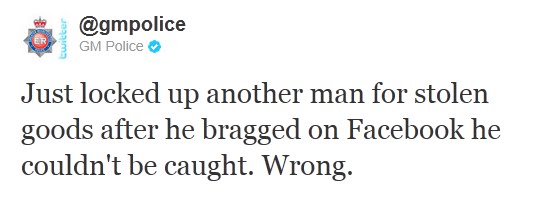


And this man is far from the only looter caught via social media. The police have been posting tweet after tweet throughout the day about arrests carried out based on information obtained by the public through photos on Flickr, through bragging on Twitter feeds and Facebook, and through other web-available sources such as Craigslist and eBay. Unlike mobile phone calls, communication by text, even through encrypted networks, leaves an electronic paper trail which police can later use as evidence. No snooping or espionage is needed to do this - all of this information was either posted openly on the internet, or was provided by members of the public with access to it.

It is hard to believe that the majority of this information would have been entrusted with the police if it had firstly not been possible to upload it, and secondly, the police were seen as being in the position of censoring the media. I no more credit David Cameron's suggestion that censorship or restriction of access might be considered, than I do his various other tough-man poses regarding the use of water cannon (dismissed by the police as unsuitable) and plastic bullets (always issued in riot conditions, but only for use in the most extreme conditions).

[Picture: Social networking of a different kind - notes posted on the smashed windows of a shop in Clapham Junction as 300 volunteer "Riot Wombles" worked to clear up the mess left behind by the looters. Picture taken by Tom Goold, a former colleague of mine in Japan, on his way back from work on Wednesday evening.]

Thursday, 11 August 2011

"I don't believe in society"


. . . why is "Because I can" a sufficient motivation?

I guess you could restate "Not believing in society" in such numerous ways with enough leeway in the interpretation that it could be seen as in some way fundamental to the answer. I don't believe in society, I don't believe in consequences, I don't believe I can succeed, I don't believe in authority, I don't believe I will ever afford these trainers, I don't believe you will ever help me, I don't believe I can be stopped - all of these are a part of saying "I don't believe in society". Without that belief, society does not function effectively.

Lacking the belief in these things, simply being able to riot becomes motivation enough . . .


My brother, over Facebook today.

PS - I'd appreciate if y'all would leave a comment or three over at my bro's place when he finally posts the piece he's doing on the riots. The above is his sentiment, and I think it's a good one.

[Picture: A burnt-out car on Clarence road, Hackney, London, uploaded by Flickr user StolenGolem, via Wikipedia]

Tuesday, 9 August 2011

The Rioters


From a Sydenham youth worker:

"When we saw my boyfriend’s bike being stolen by two hooded monsters, we ran out to get in back. I saw the youth in their faces, and shouted ‘stop I’m a youth worker!’ After some reasoning he gave the bike back. My boyfriend walked back to re-chain to our friend’s bike, but I remained. I couldn’t just let them go without asking why? He told me ‘what man, I gave the bike back?’. I replied, ‘I don’t care about the bike. It’s just a bike. I care about you. What about you? What are you good at?’ He looked at me, his smaller friend silent the whole time. ‘What are you good at!’ I yelled. ‘Nothing’. Tears pricked my eyes. Familiar tears. The ones I leave the classroom sometimes to have in the toilet. ‘Don’t say that. Don’t say nothing.’ He had no words for me. ‘You’re better than this. You’re better than being a thief.’ He was silent. What he didn’t do was run away or get angry. He didn’t pull out whatever it was he cut the bike lock with and he didn’t jab it in me. He simply looked at me, without any answers."


In the short term, the present strategy of flooding the streets of London with 16,000 police officers, enforcing the law throughout the city, and avoiding the use of any of the heavy-handed methods moronically being suggested by certain people within the media seems the best way forward. In the long term, policing in London needs to change to better avoid the antagonism that is well known to anyone living in London's poorer areas, and whilst I don't believe that more spending can be the answer, some solution must be found for the violent and crime-ridden lives of Britain's urban youth.

[Picture: Riot police in Walworth Road, Elephant and Castle, London, taken by Flickr user hozinja, via Wikipedia]

Monday, 8 August 2011

London's Burning


There are times when the expat may be given to feel that he or she no longer understands his or her country of birth. This is certainly how I've felt watching the news of the riots in London (and, now, other cities) over the past few days, although none of the people I know in London seem to understand them either.

My confusion on this is not for lack of knowledge of potential causes. The police reports about the shooting that sparked these riots seem very dubious and certainly worth investigating. Anyone who has seen the way in which certain members of the Metropolitan Police are given to harassing young men walking through certain areas in the city of London in the hope of getting an easy arrest will understand the extreme anger towards the police among youth in the city. Whilst I think it's rather early to be blaming the policies of the present government for this, the closure of youth clubs in many areas of the city cannot have helped.

However, the violence, which now seems to be growing to a scale larger than those of the riots of the early 80's, if not the same intensity, appears not,now at least, to be aimed either at the police or the government. Instead, it appears to consist merely of opportunistic arson and looting. The victims appear to be those living in the same neighbourhoods as the rioters. Whilst the initial riot was sparked by anger in the black community over a police shooting, the rioters now appear not to be of any particular background other than poor and disaffected.

[Video: A woman remonstrates with local youths in Hackney, via my good friend The Writing Baron]

Saturday, 23 July 2011

Global Times readers respond to the bombing and shootings in Norway

"唯恐中国不乱的国家!这人牛!应该颁发诺贝尔奖!"
"A country which is afraid of China's chaos [i.e., accuses China of being chaotic]! This person [the gunman] is excellent! Must give him a Nobel Prize!"

"滥发和平奖的恶果!"
"the result of spamming people with peace prizes!"

"相关部门应该好好反省一下"
"The relevant government departments should reflect deeply [apparently a reference to the Norwegian government's responsibility]"

“诺奖”颁错人,受天谴!"
"Awarded the Nobel Prize to the wrong person and received heaven's punishment!"

"强烈谴责一切形式的恐怖主义!
同时也强烈呼吁挪威人民和当局不要判安德斯死刑!!
否则就是侵犯人权!!!"
"I strongly condemn all terrorism! At the same time, I call on the Norwegian government and people not to execute Anders [the man accused of being the gunman]!! Otherwise they will violate human rights!!!"

"北约是制造这场恐怖袭击事件的真正元凶!"
"NATO is the real culprit of this terrorist attack!"

"以美国为首的西方世界应该深刻反省啦!"
"The US-led western world should reflect deeply on this!"

"哈哈 烤鸽子肉 哈哈"
"Ha Ha!, Roast dove meat! Ha Ha!"

"有本事就把奥巴马处理掉,哪才是疯狗!"
"They were able to give it [i.e., the Nobel Prize] to Obama. They really are mad dogs!"

"西方国家应该反省自己。自高自大的人不会注意自己的鼻涕流下来了"
"Western countries should reflect on their actions. Arrogant people cannot see their own snot hanging out."


And that was just the first ten comments I saw on the Huanqiu website when I opened it that weren't smilies.

Yes, it's the easiest trick in the book. When something terrible happens in a democratic country, just translate the comments about it on the Global Times (a government-owned newspaper famous for its ultra-nationalism), and hey-presto you have an instant post on government-encouraged cyber-nationalism in China, because the comments there will always be overwhelmingly devoted to gloating. Is it fair to do this? I don't know, but the comments by themselves are bad enough and worth translating for that reason.

True, the comments on Huanqiu are not representative of the entire Chinese internet (although if you look at Sina Weibo at the moment you will see more than a few similar comments) and, as certain People's Daily columnists have reminded us, the Chinese internet is not representative of the nation as a whole. However, what matters is that, whilst controls on discussing sensitive subjects like Tibet, Tiananmen, or Taiwan are very strict, discussion which goes in a direction which the government approves of (i.e., hatred of the country where the panel which awards the Nobel prize is hosted) is given free rein.

[UPDATE: as an example of what kind of discussion IS censored, see this excellent post on the high-speed railway accident at China Geeks]

Wednesday, 6 July 2011

Jiang Zemin Is Dead

And if the News of the World phone-hacking story weren't enough, Hong Kong news is reporting that Jiang Zemin has died of illness, something unreported up to now. Here's a screen grab:


Here's a link to the above picture.

Although there have been false announcments that Jiang Zemin has died before, this one has the look of truth. Jiang has cut a rather pathetic figure in recent years, with his Shanghai-based coterie losing out in the contest with the Hu/Wen and their supporters, and his previously lauded leadership becoming the object of veiled criticism from many angles, but this still does come as a little bit of a shock.

As for the effect this will have on the upcoming change in leadership, my answer is: none. Jiang was already fairly marginalised and had little influence on the outcome.

I'll post more thoughts latter if and when this is properly confirmed.

[EDIT: Question - Assuming that this news is confirmed, has release of this news been delayed so as not to cast a pall over the CCP's 90th anniversary celebrations, at which Jiang was a notable no-show?]

[UPDATE: Xinhua has released an official denial. Whilst I was originally inclined to believe the initial ATV report, I now don't know what to believe. Jiang is most likely gravely ill at the very least, but besides that, nothing is known.

For anyone wondering when the last time Jiang was seen in public was, the Guardian has the answer: October 2009 at the PRC's 60th anniversary parade, and then again last year in Sichuan closely followed by medical professionals.
]

Tuesday, 5 July 2011

A Flock Of Vampires

The tabloid newspapers in my home country are infamous for their daring, and often morally dubious reportage. Each time scandals about journalistic malpractice among the tabloids has occurred, this has brought calls for tighter controls. My instinct is always to dismiss these calls, not least because such controls will not only prevent the reporting of tittle-tattle, but also of important matters the reporting of which is in the public interest.

When the News of The World phone-hacking scandal first broke, I don't think too many people were too surprised. People are used to hearing of tabloid journalists bending the rules and even breaking the law in order to get a scoop. Even when it became known that people working for the News of the World (a News International publication) had at one point or another had been tapping the phones of most of the British cultural and political establishment, including the Prime Minister, this did not really register with the majority of readers.

However, the latest revelation that people working for the News of the World not only hacked into the voice mail account of Milly Dowler, a school girl who had gone missing, so they could record the distressed messages left by the girl's friends and family, but also deleted the messages of distress from the girl's friends and family which had filled the voice mail in-box so that more could be recorded to be used in their reporting. The girl's family were thus falsely given hope that she might still be alive, hope that was cruelly dashed when she was discovered to have been raped and murdered by a serial killer.

It is hard, after reading this, to view the staff of the News of the World involved in this affair as anything more than a criminal gang at best, and at worst as a ghoulish flock of vampires feasting on the woes of the vulnerable. Perhaps equally shocking is the failure of the authorities to have secured, other than the conviction of the private investigator who carried out the phone-taps, more than the conviction of the Royal correspondent whose too-accurate stories on Prince William helped unravel this conspiracy in the first place. This despite police reportedly being aware of being bugged at the time of the investigation into Milly Dowler's disappearance in 2002. This also despite News of the World journalists including details of Milly Dowler's voice-mail that could only have been obtained through hacking in their reporting on the case.

Equally as hard to credit is the denials of any knowledge of the phone-tapping coming from the News of the World's editorial team at the time, which in 2002 was headed by Rebekah Brooks, who went on to head up The Sun. At the very least, a chief editor who not only doesn't know that her staff are engaged in a phone-hacking campaign that must - judging by the sheer volume of taps required - have cost at least a six-figure sum to set up, or that hacked information is being included in the reporting carried in their paper, has shown very poor leadership indeed.

Back in 2002 I was living in Taiwan and marvelling over the Chu Mei-feng sex VCD scandal, where Scoop, a weekly magazine, published a illicitly filmed video showing Chu Meifeng, a minor official, having sex with a married man in a VCD carried, on their front cover. One thing I was sure of then - that kind of thing could only happen in Taiwan. Little did I know that at the same time a newspaper in the UK was doing something at least as bad, if not far worse.

Thursday, 9 June 2011

"There are no independent candidates"


Since 1978 the CCP has been toying with so-called "village elections", an experiment in a highly limited form of grassroots democracy in the people's republic. During this time, small numbers of independent candidates have been elected to various positions, like Wang Liang, who was elected to the grassroots legislature in Shenzhen.

Earlier this year it was announced that this was also going to be rolled out to include direct elections to the local People's Congress's across the country, and as a result many candidates put themselves forward for election. The most prominent story was that of Liu Ping, whose candidature was touted as an alternative to direct petitioning of the government.

I personally speculated that this might be the emergence of movement on the mainland similar to the Dangwai movement of independent candidates during the martial law period in Taiwan, whose members included Shi Mingde and Annette Lu (pictured above second and third from the right). This movement played an important part in the transition to democracy on the island.

However, it seems that the CCP have also read their history books. From today's Taipei Times:

"China told citizens yesterday not to run for local legislatures as independents, tightening reins on activists who have sought to challenge the Chinese Communist Party’s grip on grassroots government.

The warning, which came from an unnamed official of the party-controlled National People’s Congress (NPC), was in response to a small but spreading online campaign by dozens who hope to fight for seats on local legislatures with no endorsement from the party.

It was another sign that party leaders want tight political controls as they ready for a succession next year from President Hu Jintao (胡錦濤) to his presumed heir, Vice President Xi Jinping (習近平).

“There are no so-called ‘independent candidates,’ and there is no legal basis for ‘independent candidates,’” said the NPC official as quoted in the People’s Daily, the party’s main newspaper."


So all those years in which independent candidates were being elected, this was in fact illegal? This would at least be the natural conclusion to be drawn from the statements of the unidentified member of the NPC, China's highest state body and legislature, quoted in the People's Daily, a newspaper which refers to itself as "the party's mouthpiece".

I am given to agreeing that this is a sign of the influence of the new generation of leadership. It does not bode well for the future.

[Picture: The Kaohsiung Eight under arrest. Picture via Wikipedia]

Wednesday, 8 June 2011

Whilst Britain temporarily abandon's fixed wing carriers, the PRC finally acknowledges that it is building one


It is hard to remember the days when doubts surrounded what the eventual fate of the ex-Soviet aircraft Varyag would be. Back in early 2005, the extent of what any of the nerds who love to speculate on such things (in which I include myself) knew was that it had been bought, moved to Dalian, and that the promised casino/tourist attraction had not yet materialised. Over the intervening years it has steadily become more and more apparent that it was being made ready for service with the PLAN, although this was never officially confirmed.

Now, the Chinese government has finally admitted what we were all 99.99% sure of anyway - that it is being made ready as an aircraft carrier, and will enter service some time in the near future. Whilst those who previously characterised aircraft carriers as exclusively the tool of 'imperialist' and 'hegemonic' nations (trans: America and anyone else we don't like) may be mollified by the announcement that it would "definitely not sail to other countries' territorial waters", others may be concerned at the growing might that this carrier represents.

However, the simple fact is that if people are worried about this, they shouldn't be, at least not in the short term. Even if, as is expected, this ship is launched either late this year or next year, it will be a few years until it will be ready for active service, and probably more until the battle group required to escort it and sustain it is ready. Even then, its combat power is likely to be less than that of the major aircraft carriers to be found elsewhere in the world, such as France's Charles De Gaulle.

Beyond even this, even if the potential of this carrier were equal to that of the much bigger carriers owned by the US Navy, the US Navy has far more of them in the Pacific region than the PLAN is likely to have any time in the next ten years. As US Defence Secretary Robert Gates has said:

"The U.S. operates 11 large carriers, all nuclear powered. In terms of size and striking power, no other country has even one comparable ship. The U.S. Navy has 10 large-deck amphibious ships that can operate as sea bases for helicopters and vertical-takeoff jets. No other navy has more than three, and all of those navies belong to pur allies or friends. Our Navy can carry twice as many aircraft at sea as all the rest of the world combined."


All the same, as a Brit, it is hard not to draw the contrast between the state of the PLAN and that of the Royal Navy. This announcement comes just as the Royal Navy enters an interlude between the old Invincible class going out of service and the new, substantially more powerful Queen Elizabeth-class coming into service.

[Picture: The ex-Soviet aircraft carrier Varyag is towed into Dalian harbour in 2005. Via Wikicommons]

China drops Gaddafi

The CCP government never had much reason to be fond of him, they did not oppose Resolution 1973 authorising the use of force against the Gaddafi regime, and they voted for Resolution 1970 referring his government to the International Criminal Court. All the same, it is a little surprising that the PRC should agree to meet with the representatives of Libya's "rebellious provinces" before they have properly taken control of the entire country.

This is especially true in view of the PRC's intransigence elsewhere. China refused to recognise India's peaceful and consensual 1975 absorption of Sikkim until 2003, even insisting that Chinese maps should portray the country as still being independent years after it was voted out of existence by its own people.

Here's how Xinhua described the meeting:

""Chinese ambassador to Qatar Zhang Zhiliang has recently met with Chairman of the Libya's National Transitional Council (NTC) Jalil and the two sides exchanged views on the Libyan situation," Chinese Foreign Ministry spokesman Hong Lei said when responding to a question from the press.

"China's position on the Libyan situation is clear, that is, we expect the Libyan crisis can be solved through political means and believe that Libya's future should be decided by its own people," Hong said."


Could this future now include the National Transitional Council taking power in some form? The answer, at least in the view of the Chinese government, would appear to be yes, and it is taking steps in this direction. It would also appear that meeting with the leader of an internal rebellion is not quite the crime PRC leaders make it out to be, at least when other countries are concerned.

Sunday, 8 May 2011

China, Pakistan, and reverse engineering the stealth helicopter


An interesting fact that has emerged from last week's mission to kill Osama Bin Laden is that the US reportedly used a 'stealthed' version of its Blackhawk helicopter to avoid detection whilst carrying out the operation. This, of course, became known only as a result of one of the helicopters being destroyed during the raid, and fragments of it and the special coating used to baffle radar detection are now in Pakistani hands.

Of course, it may well be that Pakistan simply hands these fragments back to the US, but given past Chinese efforts to reverse engineer US stealth technology, of which I heard evidence first hand, it also seems very possible that some of this material will end up going to China. However, logically speaking, for reverse engineering to have been taking place in 2003, samples of earlier examples of this technology must already be in Chinese hands - perhaps as a result of the shooting down of an F-117 during the Kosovo campaign. It therefore seems that at worst this will give access to newer versions of the same technology.

[Picture: The canopy, ejector seat, helmet, and survival gear recovered from the crash-site of F-117A AF ser. no. 82-0806 "Something Wicked", shot down over Yugoslavia on the 27th of March 1999, on display in the Museum of Aviation, Belgrade. Via Wikicommons]

Thursday, 5 May 2011

Osama Bin Laden - consumerism junkie


This post over at my brother's place is all kinds of awesome. Money quote:

"A martyr must live a life consistent with at least his own beliefs. OBL wasn't consistent at all.

With one side of his mouth he damned the imperialist, capitalist devil infidels of the west; with the other he chugged Pepsi and Coke and chowed down on Chunky Kit-Kats ("truly a confection fit for Allah himself" he might have mumbled to himself, wiping the biscuit crumbs from his lap and washing it down with some Diet Coke: "Nothing like the real thing". He smiles to himself and leans back, before returning to his Playstation 2). "


I had even thought about it until this had been pointed out, but in its own way, this seems to reveal be the same kind of blazing hypocrisy as was seen in the 9/11 hijackers after it became known that they spent their few days on this Earth getting drunk and partying with strippers. Again and again, zealots turn out to be the very thing they attack.

[Picture: A can of Stars and Stripes Cola. Via Wikicommons]

Monday, 2 May 2011

No tears for Bin Laden . . . . .

. . . . but you have to ask, beyond the obvious meting out of rough but deserved justice to a man responsible for the death of thousands of innocent people, does this matter as much as it might have in '02, when we were still afraid of another attack like that carried out on the World Trade Centre? Given that little has been seen of him in recent years, is he really still a prominent figure in Al-Qaeda, or has he been little more than a figurehead for some years now?

Captured alive he might have given some evidence to debunk some of the conspiracy theories which have been widely disseminated since almost immediately after the 11th of September, 2001. However, since every one of these theories that I am aware of has already been thoroughly debunked, this matters less than it might. Indeed, it seems inevitable now that conspiracy theorists will fix on the details of this operation as yet more 'proof' that the 2001 attacks were an inside job.

It also might have been nice to put him on trial. However, since it is now the policy of the US government to try terrorist suspects captured in Pakistan, Afghanistan, and elsewhere before secret military tribunals, much of the impact that might have come from a Nuremburg-like trial would have been dissipated. In fact it would have probably served only to highlight the violations of the human rights at the hands of the US government of those held in Guantanamo and elsewhere.

According to the information that has come out about the taking of hostages by Bin Laden's men during the operation, it does appear that the operation was supposed to capture him alive. However, it is unlikely that any of the people involved in planning the operation will be too sorry that he died as a result of it.

Sunday, 1 May 2011

Foxconn, again.

According to a report in Saturday's Guardian, two - somewhat oddly named - NGOs, the Centre for Research on Multinational Corporations, and Students & Scholars Against Corporate Misbehaviour, have released a study of the working conditions at Foxconn's factories in Shenzhen and Chengdu. Foxconn, where I used to work, has long been accused of poor treatment of its workers.

Amongst the other disclosures in the report:

"■ Excessive overtime is routine, despite a legal limit of 36 hours a month. One payslip, seen by the Observer, indicated that the worker had performed 98 hours of overtime in a month.

■ Workers attempting to meet the huge demand for the first iPad were sometimes pressured to take only one day off in 13.

■ In some factories badly performing workers are required to be publicly humiliated in front of colleagues.

■ Crowded workers' dormitories can sleep up to 24 and are subject to strict rules. One worker told the NGO investigators that he was forced to sign a "confession letter" after illicitly using a hairdryer. In the letter he wrote: "It is my fault. I will never blow my hair inside my room. I have done something wrong. I will never do it again."

■ In the wake of a spate of suicides at Foxconn factories last summer, workers were asked to sign a statement promising not to kill themselves and pledging to "treasure their lives"."


My take on this report is that a lot of this is nothing new. The biggest item is the news that overtime limits are still being exceeded, something that Foxconn has pledged to prevent. However, when managers claim that the overtime is voluntary, they are, at least in my experience, speaking the truth.

Likewise, taking only one day off in thirteen to meet a short-term goal is nothing new either. During my time at Foxconn, which admittedly was in the patenting department, I also worked similar periods of time without a day off.

The humiliation of poorly performing workers is not a great surprise, since this kind of punishment by public loss of face is a not uncommon feature of Chinese culture, as well as that of many other East Asian countries, particularly Japan. However, I rarely saw it in my own corner of the company, and it was never taken to the extreme. The same with the self-criticism letter.

In fact, the thing which strikes me most about this report is the degree to which it shows an improvement over those of previous years. The report may pooh-pooh basic pay of 1,350 yuan a month in Chengdu, but it is significantly better that the 800-1,000 paid to people working as waiters, hairdressers etc. 24 people to a room may be considered cramped, but it is significantly better than the 100 to a room reported in 2006. You may even consider that university students in China often sleep 8 to a room and that this is the case for most of the workers I knew at Foxconn. The anti-suicide pledge is strange, but it is hard to see how it is objectionable, nor should even 14 suicides in a year be that surprising in a factory employing more than 500,000 people.

At the very least, there seems little in this report about Foxconn itself to justify the well-intended but somewhat odd editorial in Sunday's Observer, in which Lucy Siegle segues from conditions in Cambodian sweat shops (no doubt appalling) to the suicide of a South Korean man (nothing to do with 'the developing world'). Oddness aside, her central point is this:

" . . . this is a battle for human decency and that if the price of a product is to condemn fellow humans to grab a few hours sleep cheek by jowl in a concrete dormitory for a pittance, that is surely too high a price."


This is fine, but in the specific case of Foxconn, the report which she says "lays bare" conditions at electronic manufacturers in general, no one is 'condemned' to work there. Most Foxconn workers arrive from far poorer condition in the countryside, where earnings of 500 yuan a month are common. They exchange the dead-end lives in the countryside for far better earnings, and accommodation in the main no worse than that in which most Chinese university students live. By Chinese standards, there wages are not "a pittance", nor are their living conditions terrible.

For most of them, Foxconn offers the opportunity to gain new skills which many of them then market to other companies, especially Huawei. I support all constructive efforts to improve conditions for workers in developing countries, particularly those in which no democratic system which might give the workers a forum in which to voice their grievances exists. However, boycotting the products they manufacture will simply impoverish them, and truly "condemn" them to living in poor conditions on "a pittance".