.webp)
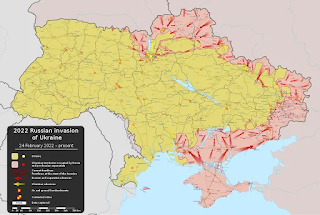
The war in Ukraine has not gone the way many more Kremlin-friendly sources would have predicted in February. Even for myself, whilst I thought it possible that Ukraine could give the Russian invaders a bloody nose, I'm not sure I would have predicted that the war could still have been going on now. Especially not with a Ukrainian victory - a rolling back of Russian forces to or across the front lines of 24 February 2022 - seeming quite possible, at least not without a direct intervention by NATO forces.
First in Kyiv, in an amazing reversal of fortunes, the disorganised attack of the Russian army was stopped and forced to withdraw after a month. That Putin was able to sell this humiliation to the Russian people as a humanitarian measure is startling but shows his all-encompassing control of the Russian information-space.
Cities like Chernihiv and Kharkhiv also stood firm against the initial Russian inrush only for the Russians to subsequently be rolled back. The only major city that fell after the first week of the war - Mariupol - was only taken after months of gruelling combat that evoked the defence of Stalingrad. After this the war settled down to months of stalemate in which the advent of NATO-donated long-range artillery systems like HIMARS shifted the advantage towards Ukraine as Russian supply depots and command-centres dozens of miles from the front were devastated in pin-point strikes.
Then in August and September the Ukrainian counter-attack began, resulting in an astounding rout of the Russia occupying forces, with Kharkiv oblast being substantially cleared and Luhansk oblast being entered. This offensive continues today with the capture of Lyman. Even if you do not believe the Russian casualty figures given out by the Ukrainian MOD (which have run at a battalion's worth of men and materiel every day for the past week), their losses in all this have undoubtedly been heavy and far in excess of the sad losses of the defenders of Ukraine.
The response of the Putin regime has been a mass-mobilisation of the Russian reserves announced last week. I expected this to happen much earlier in the conflict. Indeed, if it were going to be done at all, the best time to do it was before the war even started since the Russian forces were simply too small to ever conquer and occupy Ukraine without the reserves being mobilised. Whilst this mobilisation has seen many instances of chaos, confusion, inefficiency, corruption, and even assassination, it will (assuming it does not simply collapse under its own weight) produce forces of substantial size if dubious effectiveness.
To correct this imbalance, Ukraine needs immediate access to the latest weapons systems, including modern tanks like the Leopard 2 and Abrams M1A1, modern jets like the F-16, and modern APCs like the Marder and Bradley. Ukraine has requested these weapons many times, and the reasons given for not providing them are specious excuses for apparent bureaucratic inertia and behind-the-scenes horse-trading.
Putin has also upped the ante by declaring a formal annexation of the territories occupied by Russia within Ukraine. The rest of the world has correctly condemned this land-grab, based as it is on fake referendums conducted at gun-point. The annexation has not even been recognised by countries that Russia can typically rely on to parrot whatever line Moscow wants to push that week - the silence from Minsk, Pyongyang, Havana, Caracas and the rest has been deafening.
The use of nuclear weapons in Ukraine has been mooted by some from the Putin regime. Personally I think this kind of escalation is highly unlikely. The use of small, low-yield "battlefield nuclear weapons" (i.e., tactical ones) holds out little hope for Russia unless used in large quantities since, once the initial psychological effect wears off, the use of one or two of them on the battlefield will at most obliterate only a small portion of the Ukrainian army (the typical target even for a 10kt tactical nuclear weapon is a company-sized unit). Needless to say using them in large quantities will irradiate large parts of both Ukraine and Russia, particularly given prevailing winds being out of eastern Ukraine and into Russia. The threat of NATO retaliation for their use, and complete international isolation and condemnation for breaching the nuclear taboo, would deter them being used even if Putin is tempted to do so. It should be pointed out that there are many steps on the escalation ladder between where we are now and the use of nuclear weapons, including (in no particular order) the formal declaration of war by Russia, the use of chemical weapons, a further invasion of Ukraine outside of the Donbas region, and other steps.
More likely in my view is a play for getting more international support for Russia's war. This would explain the reason for Putin practically declaring a crusade against the western alliance in his demented speech this past week. So far even governments like those controlling Transnistria, Abkhazia, Kazakhstan, and Belarus have not sent their troops to fight in Ukraine, but the mass of troops being mobilised by Moscow may provide the necessary leverage to push them to do so. These are, however, of little consequence - the most important building block of that kind of strategy would be the support of the PRC.
It now appears that, with or without the knowledge of the Chinese government, some Chinese companies have been providing Russia with military supplies as well as helping Russia bypass sanctions. China has thus far shied away from providing weapons (or at least weapons-systems easily identifiable as Chinese) to Russia, but it is an open question as to whether Beijing actually wants to see a Russian defeat or the unseating of Putin, and whether, if push comes to shove, they would not be willing to step in to supply Russia. A Russia entirely indebted to Beijing might be an attractive prospect, but this might be obtained in a number of ways, nor is attaching themselves to a losing and morally bankrupt cause likely go down well domestically (in as much as Xi Jinping cares about such things).
Without such support Russia is condemned to slowly lose this war if NATO continues to provide full backing to Ukraine. It is a great sadness that this war will continue to kill hundreds or even thousands of people, mostly innocent Ukrainian civilians, each day until Russia finally abandons this imperialist project.